The method of Streltsov's of improvement of
the electric conductivity of a wire or the foil, made from amorphous metals.
The room-temperature superconductivity?
In last years, after opening of the high-temperature superconducting ceramics the scientific community has laid down for itself the aim to receive so-called " room-temperature superconductivity ".
The declared mode is based on the experience, described in magazine "The science and a life" № 11 for 1990 in article: "New professions of a tunnel microscope", where it has been talk about making by means of a tunnel microscope of the channel of ideal conductivity of an electric current
This experience is so interesting, that, certainly, deserves so as here I showed the corresponding paragraph from specified article:
ideally built molecular structureeffect of ideal conductivityof ideal conductivity
The tunnel nanotechnology
vanishingly small resistance of the conductive channel, kept and at a room temperature.
Right, than it not room-temperature superconductivity
The specified experience allows to hope, that if we will do the quickly freeze of the liquid metal, through which we passes an electric current, then we can receive in the frozen product such structure of disposition of atoms, which will show smaller resistance to an electric current. Probably, even it will be possible to receive and so-called the room-temperature superconductivity.
Where by numbers are designated: 1 - the molten metal, 2 - a cooling liquid, 3 - a source of an electric current.
In the further at fast cooling of the molten metal this additional orderliness will trapped (frozen) in a solid product and, as a consequence, in a product (in a wire or a foil) arises the lengthy channel of the improved electroconductivitythe room-temperature superconductivity
The idea of technological process, which I describe here, is very simple, therefore I cannot assert with full certainty, what earlier nobody did not try to carry out similar experiments.
However, I am, the author of it Web the site, did not meet in Internet of the sources of the information, in which somebody would express the similar ideas on improvement of electric conductivity of a wire or a foil, or methods of production of room-temperature superconductivitymethod of getting of room-temperature superconductivitythe room-temperature superconductivityhttp://alekssreltsov9.narod.ruthe nuclear synthesis: http://nucleafusion.narod.runuclear synthesisthe room-temperature superconductivity
Now we shall discuss some additional questions
The wire (the foil) with
the improved electroconductivity, received by the mode, described here,
can find use in various sensors, aerials, generators, electromagnets, etc.
Besides it is quite probable, that owing to the declared mode it will be possible to make the multiple cables, which allow to transfer the electric power on a greater distances with small losses. (In this case we can use just the multicore cables, where in one bunch we keep within a lot of thin wires from the amorphous alloys with the improved electric conductivity, isolated from each other. Elementary physical reasonings allow to draw a conclusion, what to make continuous thick, i.e. not from a set thin wires, the cable with improved electroconductivity in the specified way will not be possible.)
Also I wish to pay attention to a some circumstances:
The firstly, probably, that prospective effect of improvement of electric conductivity will very strongly depend from deformation of a ware (of a wire or a foil) and he can be irreversible, i.e. disappear at strong bends in consequence of the deformative destruction of the atomic structure of the channel of the improved conductivity
Where I is conditionally shown the long multicore cable, which consist from three thin wires. On each such wire, which use into a cable, there is the electronic equipment, for preventing increase of value of an electric current above a certain level (on a
drawing 2 this device is conditionally designated by a rheostat, operated by the ammeter).
the property of superconductivityreceive absolute (ideal) superconductivitythe absolute (ideal) superconductivityeffect of superconductivitysuperconducting wiresthe room superconductivity
For consecutive connection of two thin quasi-superconductive wiresquasi-superconductive thin wiresquasi-superconductive wiresof cold vacuum welding:
For transfer of an alternating current on greater distances
Where numbers 1 and 2 designate the input transformer and the output transformer, by numbers 3 and 4 - two long multicore cables (in our case the triple-core cable).
Between wires, using into cables, the transformer decoupling is used - the each pair of wires in the cables are connected only to the own coils. Distribution of a variable electric current on all wires of multicore cables will steady.
Besides it is necessary to note, that at such connection at any moment in each wire of the multicore cables 3 or 4 electric current flows in one direction, i.e. the difference of electric potentials between separate wires in each cable is minimal, what reduces probability of electric breakdown of isolation between wires of a cable.
In quality of funny case it is possible to consider an opportunity of creation of plastic superconductive wiresplastic superconductive wireschannel of ideal conductivity
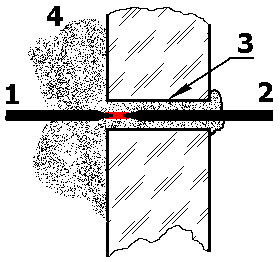
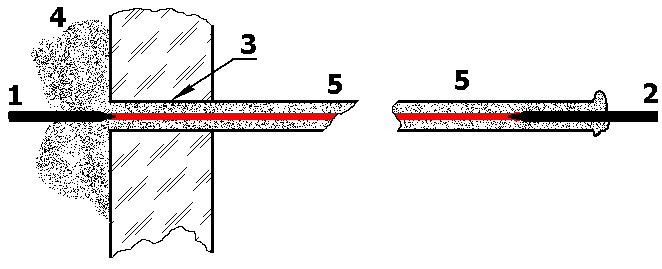
By means of the numbers 1 and 2 I designate - the needles, similar to what are applied in tunnel microscopes. Since these needles have small thickness, then they will easily be located along an axis of the ceramic forming plate 3.
At an initial stage of process of an edge of needles are connivent together with each other, therefore under action of the strong electric voltage in the polymeric mass 4, which fill the aperture of the ceramic forming plate, the primary channel of ideal conductivity
So it is possible to try to receive the plastic superconductivity filaments the plastic superconductivity filaments
The
little note not to a theme.
Recently in newspapers and on TV begin much to speak about an
opportunity of creation so-called "Avatar" -
remotely controlled anthropomorphous robot. For
example, recently the DARPA has declared, that the government of the USA
apportion 7 million dollars on researches in this area ( talk be about
creation of fundamentally new interface between the person and robot).
These researches try to present as sensation. In reality the problem of
remote control of robot in the theory already for a long time is solved: http://deepdivertech.narod.ru/rd.htm